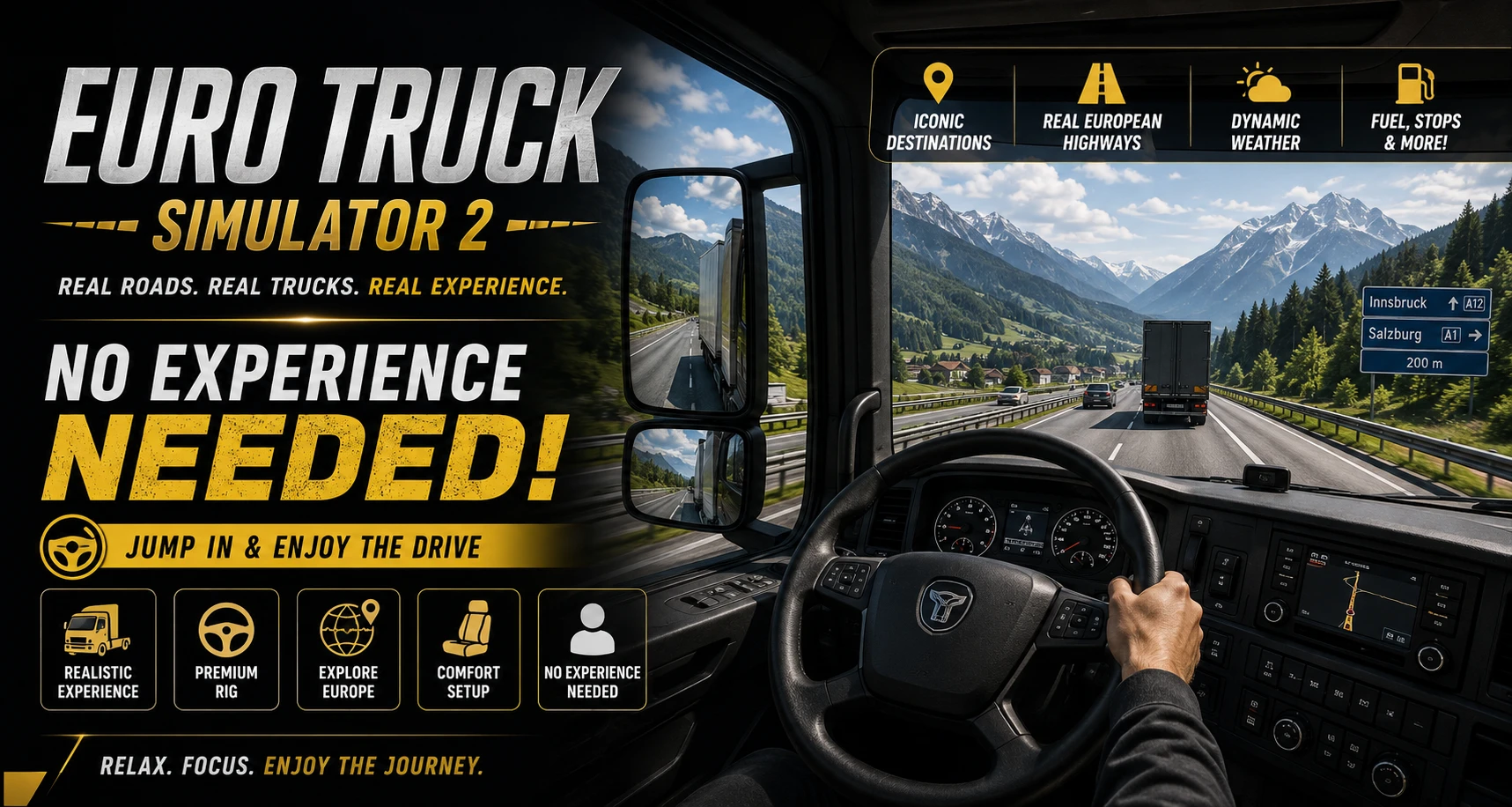
The first time you sit in a real truck cab, everything is unfamiliar at once. The seat is higher than you expect. The nose in front of you is long. You cannot see anything directly behind you, and the trailer does not go where you point it. Most people spend their first few hours of heavy vehicle training simply getting used to the size of the thing.
That is expensive time: diesel, an instructor, a yard slot and a vehicle you are nervous about scratching. There is a cheaper place to burn through the awkward part — Euro Truck Simulator 2, on a proper rig, before or alongside your real training.
What Euro Truck Simulator 2 actually is
It is a simulator, not an arcade game. You drive an articulated truck across long European routes, hook and unhook trailers, reverse into loading bays, manage fuel and rest stops, and get scored on how much damage you do to the cargo and the truck. Rush, and the score says so.
It also ships with a driving academy mode: guided lessons that walk through the basics one at a time. Coupling a trailer. Reversing into a bay. Using your mirrors. Parking without clipping anything. It is the closest thing to a driving school you can run indoors, on repeat, as many times as you like.
We run it on the ROOKIE seat, and the reason it lives there is the gearstick: a real H-pattern shifter and a clutch pedal at your left hand, twelve gears of honest work. Changing gear by hand is most of what makes a truck feel like a truck rather than a large car.
What actually carries over to a real truck
Be honest about this part. A simulator will not teach you everything. But a few things transfer surprisingly well, and they happen to be the ones learners struggle with most.
Reversing an articulated trailer is the big one. The counter-intuitive steering, watching the trailer pivot, knowing the moment to straighten out — that is a mental model, and your brain builds it the same way whether the truck is real or rendered. It is also a set piece in the practical test.
- Mirror discipline. In a truck the mirrors are not optional, and in the sim, if you do not check them, you clip something. The habit comes with you into the real cab.
- Judging length and tail swing. Going wider and later into a turn because the trailer will cut the corner is repetition, not theory. You can do it fifty times in one session.
- Gear discipline. Set the game to full manual with no assists and you are holding revs in range and picking a gear on a climb exactly as you would for real.
- Patience. Trucks reward slow, planned, deliberate driving, and the sim punishes rushing in the same way the road does.
What does not carry over
We are not going to pretend otherwise.
- Clutch feel and the bite point. No simulator gives you this. You learn it in a real vehicle.
- Air brakes. Pressure building, brake fade, engine braking down a long descent — you feel those in your body, not through a screen.
- Weight transfer. A loaded trailer shifts and settles behind you. That one is road-only.
- Indian road conditions. ETS2 is European: left-hand drive, traffic on the right, disciplined lanes, good surfaces. Our roads are a different exam entirely.
- Consequences. In the game you press R and start the manoeuvre again. On the road you do not.
And to be very clear: simulator hours count for nothing towards a licence. You still need training from a government-approved heavy vehicle driving school, and your test happens in a real truck at the RTO. Treat the sim as practice between lessons, never as a replacement for them.
Getting an HMV licence in India — the short version
If you are at the start of this, the shape of it is roughly as follows. Rules vary a little by state and do change, so treat this as orientation and confirm the detail with your own RTO before you plan around it.
- Minimum age is 20 in most states, though a few differ.
- You generally need to have held a valid LMV licence for at least a year, or to complete training at a government-recognised heavy vehicle driving school.
- Training from an RTO-approved school is mandatory, and you will need a Form 1A medical certificate.
- Applications go through the Parivahan Sarathi portal.
- The practical test looks at handling on an incline, reversing in a confined space, lane discipline, signalling, and how well you manage your blind spots.
Read that last line again. Reversing in a confined space, and blind spots. Those are precisely the two things you can rehearse a hundred times in a simulator for a fraction of what an hour in a real truck costs.
How to make a session actually useful
If you are coming in to practise rather than to play, set it up like this:
- Turn the assists off. Manual transmission, no parking assist, realistic braking, damage on.
- Sit in cockpit view. No chase camera. Mirrors only, like the real thing.
- Pick one drill and repeat it. Do not drive across Europe — spend the whole session doing blind-side reverses into a bay until you stop having to think about which way to turn.
- Watch the damage score. It is honest feedback: if cargo damage is climbing, you are rushing.
- Then repeat it in the yard. Everything you drill here is worth re-testing with your instructor at the next lesson.
Come and try it
We are in Guindy, Chennai, a short hop from Kathipara, and you can walk in. Ask for the ROOKIE seat: gear-driven wheel, real H-pattern shifter and clutch, one big screen. If you would rather have the mirrors and the side windows roughly where a real cab puts them, the PODIUM wraps three screens around you and its direct-drive wheel is stronger again. See the pricing to plan a stint, or the game library for what else is on the floor.
Walk in, tell us you are learning to drive a truck, and we will set the academy mode up for you.